The Camp Conundrum

As mentioned in my previous post The Drages of Barkway, earlier this year I found out that my 5xgreat-grandfather was John Camp, who in 1799 was living in the hamlet of Newsells near Barkway in Hertfordshire. However, tracing his branch of the family tree turned out to be no easy task.

At the time of the Rev. Thomas Bargus’s 1799 census of Reed and Barkway there were two heads of household named John Camp, one living in each parish. But searching through the records reveals a puzzle:
1769, Reed: Marriage of John Camp and Sarah Bysouth
1781, Barkway: Baptism of John Camp, son of Edward and Hannah
1792, Barkway: Marriage of John Camp and Emme Bonham
1797, Reed: Marriage of John Camp and Sarah Whitacks
1799, Reed: “Census” entry for John and Sarah Camp plus four children, ranging in age from 11 to 1.
1799, Barkway: “Census” entry for John and Emma Camp plus three children, ages 5 to 1. Marked “Dissenters”.
1833, Reed: Burial of John Camp aged 85
1818, Barkway: Burial of Mrs Camp, wife of John, aged 50
1820, Barkway: Marriage of John Camp, widower, and Sarah Pateman
1843, Barkway: Burial of Sarah Camp, wife of John Camp. (Age not given.)
1846, Barkway: Burial of John Camp aged 77
So that’s one John Camp baptism, four John Camp marriages (three of them to a Sarah), no baptisms of children of John Camp, two John Camp burials, and only one Sarah Camp burial. The numbers don’t add up!

Here is the list again, annotated to indicate my current thoughts on the tangle.
1769, Reed: Marriage of John Camp (A) and Sarah Bysouth (X)
1781, Barkway: Baptism of John Camp (C), son of Edward and Hannah
1792, Barkway: Marriage of John Camp (B) and Emme Bonham (E)
1797, Reed: Marriage of John Camp (A) and Sarah Whitacks (Y)
1799, Reed: “Census” entry for John (A) and Sarah (Y) Camp plus four children, ranging in age from 11 to 1.
1799, Barkway: “Census” entry for John (B) and Emma (E) Camp plus three children, ages 5 to 1. Marked “Dissenters”.
1833, Reed: Burial of John Camp (A) aged 85
1818, Barkway: Burial of Mrs Camp (E), wife of John, aged 50
1820, Barkway: Marriage of John Camp (B), widower, and Sarah Pateman (Z)
1843, Barkway: Burial of Sarah Camp, wife of John Camp. (Age not given.) (Z)
1846, Barkway: Burial of John Camp aged 77 (B)

There is an age-gap the two youngest children in the John-Sarah household in the 1799 “census” which could be explained by a child’s death, but it could also indicate the death of John’s first wife and his remarriage to a second. The age of the youngest child, Elizabeth, would be consistent with her being the offspring of the marriage of John A and Sarah Y. But if John A’s marriage to Sarah Y was a remarriage, why is there no burial record for Sarah X? I believe it’s for the same reason that there are no baptism records for the
children of the John-Sarah household, even though the entry is not marked “Dissenters” or “children not baptized”. A History of the County of Hertford: Volume 3 notes with regard to Reed that “In 1830 there was a book (ii) baptisms and burials 1768 to 1812, but this has since disappeared”, and I have not been able to find any bishop’s transcripts for Reed pre-dating 1800. This, in combination with the non-conformism of John and Emma Camp noted in the “census”, would explain why I can find no baptisms of children of John Camp and no burial entry for Sarah X. (I did check the Royston and District Family History Society’s Monumental Inscriptions St. Mary’s Church, Reed, Herts. booklet, but found no entry there either.)

But where is the burial for Sarah Y? Going back to the records I found that a Sarah Camp, widow, married Thomas Anderson in Reed in 1837, and a Sarah Anderson was buried in Reed in 1838, aged 59. This is consistent with Sarah Anderson being the Sarah Wittocks who was baptised in Sandon in 1778, so I think there are reasonable grounds to identify Sarah Anderson with Sarah Y. And if Sarah Y was a widow in 1837, then this is consistent with John A being the John Camp buried in Reed in 1833.

And the burial entry for Sarah Z? The ‘Mrs Camp’ buried in 1818 aged 50 was almost certainly Emma E. Emma Bonham was baptised in Barley in 1768, and in 1822 her maternal aunt, Etheldreda Brett, stated in a codicil to her will that “my Nephew Caesar Bonham and my Niece Emma Camp have departed this life” (Caesar’s burial is actually recorded on the same page of the register as Mrs Camp’s). So that leaves the 1846 burial of Sarah Camp to be the burial of Sarah Z.

So in the absence of evidence of parentage like a baptism or will I haven’t been able to trace my 5xgreat-grandfather’s line any further back (although given the year of birth suggested by his age at burial I suspect that he could well have been the son of John A and Sarah X), but I hope that I have at least been able to cast some light on the relationships of the John and Sarah Camps mentioned in the records.
Posted in Uncategorized | Leave a comment

The Drages of Barkway

One of the family stories told to me by my grandmother was that her grandmother, Fanny Ann Miller, was married three times and that during what turned out to be her final illness her plan for when she recovered was to dye her hair blonde and go looking for husband number four! Because my grandmother knew Fanny’s maiden name, the certificates relating to her family were among the first I ordered when I started my research in 2008, but I quickly became stuck when I tried to trace her mother’s family.

Fanny’s birth certificate stated that she was the daughter of Charles Miller and Jane Camp. Charles and Jane’s marriage certificate stated that Jane was the daughter of William Camp, and Jane’s census entries gave her place of birth as Royston, Cambridgeshire* in about 1824. One of the witnesses on the marriage certificate was a Ruth Camp, and since in the 1851 census there are only four Ruth Camps listed in England and two of them are the wife and daughter of William Camp, living in Melbourn in Cambridgeshire, I figured that Jane probably belonged to that family. I found a certificate for a marriage of William Camp and Ruth Drage in Barkway, Hertfordshire in 1815, but I was unable to find a baptism to link Jane to William and Ruth. Because Charles and Jane married at the Aenon Chapel in Marylebone I suspected that the family were non-conformists and thought that the likelihood was that there was no baptism to be found, so I turned my attention to other branches of my family.

In 2013 I discovered the BMD registers site and my belief that non-conformists did not baptise their children was proved wrong, as I found baptisms for William, John and Ruth Camp, children of William and Ruth, at the New Meeting House in Royston – but still nothing for Jane. The National Archives catalogue page said that the RG4/96 document containing the baptisms covered 1806-1837, but the entries from it available on the site started in 1830. I contacted the site and they explained that 1806 referred to birth dates, not the dates of the baptisms. They also sent me an image of a a note from Thomas James Davies, who performed the baptisms, explaining that prior to 1829 baptisms had been entered into books containing ‘matters of discipline’ which were ‘private & are kept strictly so by the Minister’. So once again I gave up tracing that line of my family tree.

Then at the beginning of May this year I visited a family history fair near where I live and started leafing through a booklet on non-conformists at the stall of the Hertfordshire Family Society, looking for a mention of Barkway. A lady asked what I was looking for, and when I mentioned the village she told me that there was an expert on the area at the fair. When I found the gentleman in question he most kindly forwent his tea-break to show me his records. Not only did he have a document on William and Ruth, but he had the names of their parents and some children I didn’t know about too! He told me that Ruth was actually from Newsells, which is just outside Barkway.

That afternoon, inspired to look for more information on the family, I was thrilled to discover that the earlier baptisms at the New Meeting House which I’d been unable to find in 2013 were recorded in document NR7/1/1 held at the Hertfordshire Archives, and included baptisms for Jane and Hannah, children of William and Ruth. Finally I had enough evidence to step back a further generation! I also found the family’s 1841 census entry, which I’d missed previously because the surname had been mis-transcribed in the index of the site I was using.

I was still puzzled about how the local expert knew about William and Ruth’s parents, given that I still couldn’t find any baptisms for them. Some days later, when Googling for family names in the area I discovered that in 1799 the recently-appointed Rector of Barkway, Rev. Thomas Bargus, compiled a census of the parishioners of Barkway and Reed. Once I obtained a copy I found young Ruth and William: Ruth was the daughter of William, whose wife was called Ann, and William was the son of John, whose wife was called Emma.** And the families were marked as ‘Dissenters’/’children not baptised’.

I went back to the national censuses and had another stroke of luck – not only were William and Ann Drage still alive in 1841, but the entry set me off on a trail resulting in the identification of six possible children born after the 1799 census (listed in order of the strength of the evidence, not birth order).

Mary, Lucy and Etheldreda
Information from the national censuses makes it possible to identify with confidence three other daughters of William Drage: Mary, Lucy, and Etheldreda (‘Etheldreda’ being the name of an Anglo-Saxon saint who built a monastery at Ely, Cambridgeshire). Etheldreda Drage, born in Barkway in about 1813, married James Jeffery in 1839, so her marriage certificate gives her father’s name: William Drage. In 1841 Etheldreda, James and Christopher Jeffery were living with William and Ann Drage in Barkway. In 1851 Ann had died; Etheldreda is stated to be William’s daughter. By this time, Etheldreda and James had had two more children, Walter and Julia. In 1861 James had died and Etheldreda and Walter had moved to Great Chesterford, James’s birth-place; Christopher had stayed in Barkway but had moved next door to live with an aunt and uncle, William and Mary Howard. Mary Drage was born in Barkway in about 1806. She married William Howard in Barley in 1833 and one of the witnesses was Etheldreda Drage. In 1871 Etheldreda was living in Tottenham with her sister Lucy Stacey, who was born in Barkway in about 1814. Lucy Drage had married Charles Stacey in Barkway in 1836. (Intriguingly, one of the witnesses to Charles and Lucy’s marriage is a Thilla Drage; I haven’t been able to find any trace of an individual by that name in any of the record collections to which I have access.)

Maria
Maria Drage was born in Barkway/Newsells in about 1804 and married Thomas Blackeby in Barkway in 1822. In 1841 they were living in Bishops Stortford (where Lucy was living in 1851). By 1851 Maria was widowed and living in Marylebone; also living in Marylebone, at 10 Occus Street, was William Blackerby, born in 1823 in Bishops Stortford. When Charles Miller had married Ruth’s daughter Jane in Marylebone a few weeks earlier he gave his address as 10 Occus Street, and one of the witnesses on the certificate was William Blackaby.

Jemima
Jemima Drage was born in Barkway/Newsells in about 1800. One possible piece of evidence for a link between Jemima and William and Ann is a rather perplexing record of the baptism at St George Hanover Square in 1818 of a Jemima Drage, daughter of William and Anne. (I find the record perplexing because there is no indication that this Jemima isn’t an infant, and why would the daughter of William and Ann, alone among her siblings, be baptised as an adult?) There is also a possible link to Ann’s family. The ages of Ruth and her sister Elizabeth in the 1799 census suggest that their parents were the William Drage and Ann Wattson/Watson who married in Barkway in 1795 (the person filling in the register spelled the Ann’s surname with two ‘t’s, but Ann signed her name with only one). At first I leaped to the conclusion that Ann must be the Ann Wattson baptised in Royston in November 1776, but then two factors combined to make me think that they were different children: Ann’s death certificate suggests a birth year of 1775, a year older than the Royston Ann, and one of the witnesses at the 1795 wedding was a Lot Watson, who is not among the Royston siblings. There was a younger Lot Watson in Barkway; when he married from the second time in 1837 his father was stated to be William Watson, and I thought it not unlikely that Lot the younger might be named after an uncle. So I began to think that perhaps there were three siblings, Ann, Lot and William, and since I couldn’t find baptisms for them then they could be from a non-conformist family. There are five Watson families listed in the 1799 census, only one of which is marked ‘Dissenters’ (in fact, the father, John Watson, is noted as ‘Clerk to Meeting’). The range of ages of his children would be consistent with them having some older married siblings; the eldest is Ruth, aged 13. A Ruth Watson married a Thomas Arrowsmith at St Martin in the Fields in 1812, and in 1820 a Thomas and Ruth Arrowsmith are the witnesses to Jemima’s marriage to George Evans at the same church.

Samuel
Samuel Drage was born in Barkway in about 1808. The witnesses at his 1828 wedding to Martha Taylor were Etheldreda Drage and a John Watson (possibly an uncle or cousin), and when his daughter Keziah married at St Peters Walworth in 1856 she was living at 46 Francis Street (where Jemima was living in 1851 and 1861) and one of the witnesses was a Jemima Evans.

So the moral of the story is not to give up even if you think you have hit a brick wall – information might be out there somewhere!

* Today Royston is wholly in Hertfordshire, but the boundary between the counties used to run through the middle of the town.
** Please see my blog post My ‘Irish’ Ancestor for a story illustrating why it is unwise to assume that children of the head of household are also the children of his wife, even if she has the same name as the woman you know he married!
Posted in Uncategorized | 4 Comments

My “Irish” Ancestor

One of the family stories passed down to me from my childhood was that my great-grandfather, Thomas Fitzgerald, was Irish. One of the very first family documents that I saw when I started my research was a baptism certificate for him, which stated that he was the son of James Fitzgerald and Honora Coughlin, he was born on 28 September 1871, and he was baptised on 8 October the same year at the Catholic Church on Commercial Road in London. That immediately put paid to that family story! But was he from an Irish family?

I found James and Honora’s marriage in August 1867 quite easily, and then their entry in the 1871 census. At that time they were living in the same house (but listed as a different household) as Honora’s father John, his wife Catherine, and his sons John, Dennis and Jeremiah. Neither James nor Honora was born in Ireland, but John and Catherine were; the writing is hard to make out but looks like it says ‘Ireland Kild’. As mentioned in my first blog post back in 2011, at the WDYTYA Live event that year I spoke to a representative of the National Archives of Ireland who said that the names Honora and Jeremiah Coughlin suggested that the family came from the province of Munster; if ‘Kild’ is short for ‘Kildare’ then they were from Leinster. But unfortunately neither the 1881 or 1861 censuses give any more information on their place of origin and although I’ve looked through the whole Ratcliff section of the 1851 census on Ancestry.co.uk I haven’t been able to find the family in that year.

One significant barrier to my research into this branch of the family has been the number of variant spellings of Coughlin. So far I have found:

  • Coughlin
  • Coughlan
  • Caughlin
  • Cochlin
  • Cocklin
  • Cockling

– and these are just the variants found in documents relating to my family (I have seen other variants too).

I did manage to track down birth certificates for Honora’s two youngest brothers; they were Catherine’s sons and her maiden name was Sullivan. The marital history of one of them, Jeremiah, explains why I am not willing to identify Catherine as the mother of all of John’s children… In 1901, Jeremiah was living with wife Elizabeth and daughter Catherine. Catherine was born in 1884, the daughter of Jeremiah and his wife Elizabeth Stevens. But the Elizabeth in the 1901 census is Elizabeth Flood, whom Jeremiah married in 1889 following the death of Elizabeth Stevens nine days after Catherine’s birth. Honora too was widowed young and remarried. James died some time between the 1871 census and July 1875, when Honora married George Black.

The most likely death certificate I have found for James is from April 1873: James Fitzgerald aged 24 died at the Sick Asylum in Bromley. The age at death isn’t consistent with the age given for my ancestor in the 1871 census or on his marriage certificate, but those two documents suggest different years of birth anyway. (In September this year I visited the Royal London Hospital Archives to try to get more information about the James Fitzgerald who died in the Sick Asylum. Excitingly, the admission entries for the Sick Asylum include information on nearest relative and address; frustratingly, the first register that the archive holds begins in March 1873, presumably after James’s admission as I couldn’t find a record of it.) Given the inconsistencies in his recorded age I have not been able to trace James prior to his marriage to find out if he, like his wife, was of Irish descent.

So after five years of research all I can say with confidence about my “Irish” ancestor is that he had at least one Irish grandparent!

Posted in Uncategorized | Leave a comment

Some London Churches Associated with my Ancestors

This gallery contains 14 photos.

This week I was in London for a conference and took the opportunity to visit some of the churches in the area associated with my ancestors. St Ethelburga’s Bishopsgate James Okell and Ann Yaxley were married here in 1793. St … Continue reading

More Galleries | Leave a comment

Tentative Identifications

Today I’ve updated my site to include a new section on the pages listing person details – ‘Possibly the Same Person?’.

In a number of cases I have documents which may relate to a particular person in my family tree, but I can’t cross-reference them on enough details to make me feel confident that they do actually relate to that person. For example, I have a death certificate for a Henry Asher who is the right age and has the right occupation to be my ancestor, but he died in the London Hospital in Whitechapel when all the other documents I have which definitely relate to my ancestor place him in Croydon.

So I’ve decided that in these cases I will add the document to my site, but attached to a new person who I will then link to my ancestor. That way, it will be easy either to merge the people (if I find further evidence that the records do relate to the same person) or break the link (if I find evidence to the contrary). To see information on the the details I have considered in making the link, you can click on the icon next to the name.

I have started with documents relating to some members of the Ellis family (James, Martha and John) and to Henry Asher; documents relating to other branches of my family tree will follow in due course.

Posted in Uncategorized | Leave a comment

‘Choked to Death Eating a Sausage’ and other unusual deaths

Most of my ancestors seem to have died in quite unextraordinary ways – mostly cardio-vascular or pulmonary disease and old age. But some of them have met their ends in more unusual ways.

‘CHOKED TO DEATH EATING A SAUSAGE’ was the attention-grabbing headline of the local newspaper report on the death of Thomas Bushby Olliver in September 1953. The coroner’s inquest was told that he ‘gobbled his food’ and had had a previous episode of choking some months before. Thomas’s son Denis Raymond Olliver also liked his food, dying of morbid obesity in 2000. In contrast, Charles Parkes died of marasmus, a type of malnutrition, in 1858.

Some of the deaths are notable for their timing: Denis’s grandmother Alice Chapman died in 1910 four weeks after giving birth, and her mother Susannah Wells Hooper died some months after falling down the stairs on Christmas Day 1916. Others are notable for their location: Joseph Bowhill suffered an attack of apoplexy while incarcerated in the County Gaol in Maidstone, while Charles Parkes, his mother, Louisa Elizabeth Tonks, and grandmother, Charlotte Rothery Newman, all died in Shoreditch workhouse. And poor William Upton did away with himself in the lavatory.

Posted in Uncategorized | Leave a comment

The Tonks Family of Shoreditch

I hadn’t intended to write a blog post on the Tonks family, but as I pulled together the data I had collected for August’s website update I found I was creating so many “Did You Know”s to highlight connections it seemed worth bringing the information together in one place.

Henry Tonks married Charlotte Rothery Newman at Saint Botolph Aldgate in 1822 and their son Henry Joseph was baptised seven months later in Walthamstow. Several of their subsequent children died in childhood: Charlotte Rothery in 1828, Caroline Harriet and William Alfred in 1837, and Frederick Edward in 1845. (I don’t have any direct evidence that William Alfred was their son, since I haven’t found him in the baptism records and he was born some time around March 1837 before civil registration began, but he was buried on the same day as Caroline Harriet at St John the Baptist in Hoxton, the ‘Abode’ listed in the register was the same street, and his age at burial suggests a birth date which fits in the ‘gap’ between Sarah Jane and Ellen Tonks.) However, Henry Joseph, Louisa Elizabeth, a second Charlotte Rothery, Mary Ann, Sarah Jane, Ellen, Caroline and Augusta Sophia all survived to adulthood.

I was surprised that Henry Joseph was baptised in Walthamstow, since Henry and Charlotte’s other children were baptised at St Leonard Shoreditch. There may have been some kind of family connection with Walthamstow, though, as it is given as the birthplace of Henry’s brother Thomas in the 1851 census. (Thomas and Henry were two of the sons of Joseph Tonks and Ann Chandler, and were baptised in St Luke’s Finsbury in 1795 and 1800 respectively.) In the 1830s Thomas and his wife Sophia were apparently living close to Henry and Charlotte, as the brothers had children baptised on the same day on two occasions:

  • Charlotte Rothery and her cousins Emma, Frederick, Eliza, and Charles Thomas Tonks were all baptised at St Leonard Shoreditch on 27 July 1831
  • Sarah Jane, her sister Ellen and their cousin Thomas Henry Tonks were all baptised at St Leonard Shoreditch on 15 September 1839, at which time both families were living in George’s Place

Louisa was the first to marry, in 1845, to a painter called John Charles Parkes; her brother Henry Joseph was working as a painter when he married in 1848, and Caroline and Ellen also married painters (who were half-brothers): Ellen married Edwin William Bartle in 1862 and Caroline married James Joseph Bartle in 1869. Both these marriages would be cut short by early death: Eleanor had been widowed twice by 1891, and Caroline was widowed in 1874 after less than five years of marriage.

Charlotte Rothery Newman had signed her own name in the marriage register, but her daughters Louisa, Mary Ann and Ellen made marks on their marriage register entries instead, as did Sarah Jane when she registered their father’s death. (Strangely, although Louisa and her husband John made marks when they signed the register after their own marriage, they signed their names when they witnessed Mary Ann’s marriage.) Interestingly, the two youngest daughters both signed the marriage register themselves, in a clear hand, as did Louisa’s daughter Jacintha Augusta Parks. My suspicion is that these girls had received an education at the workhouse.

Misfortune had struck the family in the 1850s: Henry died of an epileptic fit in 1852, then Charlotte’s death of paralysis in Shoreditch Workhouse in 1855 left their children orphaned; the youngest, Caroline and Augusta, were 14 and about 11. Then in early 1858 Louisa and her little son Charles Parkes also died in the workhouse. Like her mother, Louisa died of paralysis; Charles was 23 months old when he died of ‘Marasmus’, a type of malnutrition, a few weeks later. (There is a grim account of conditions at Shoreditch Workhouse in the 1860s on the Workhouse website.) At the time of the 1861 census Louisa’s younger surviving children, Edwin, Catherine and Emily, were living at the workhouse’s Shoreditch Industrial School in Brentwood, but I have been unable to locate Jacintha or her two youngest aunts. My guess is that they were associated in some way with the workhouse and were taught to write there.

By the late 1860s several of the girls had moved south of the river. Banns were read for an Eleanor Tonks and Edwin Craddock, both minors, at St Mary Newington in January 1858; nothing seems to have come of this, but in 1861 Ellen (now known as Eleanor) was in Lambeth visiting James Brown, who with Ellen’s sister Caroline would be a witness at her marriage at the Trinity church in St Mary Newington the next year. In November 1867 Augusta married at the same church, and her marriage was witnessed by Louisa’s daughter Jacintha and Ellen’s husband Edwin.

It is not clear what further contact there was between Jacintha and her aunts, but there are a number of coincidences between the places where Ellen and Jacintha lived:

  • In 1871 Ellen was living at 52 Oakley Street; in April 1867 Jacintha had given birth to a daughter in Kynaston Street, off Oakley Street.
  • In 1891 Ellen was living at 26 Boundary Lane in Camberwell; there are records of Jacintha living in Boundary Lane between 1901 and 1904.
  • In 1901 Ellen was living at 82 Lorrimore Street in Newington; Jacintha’s daughter Jacintha Augusta Williams had been resident at number 12 when she married George Tovey in 1886.

Perhaps there was a professional connection between Ellen and Jacintha; Ellen, her daughter Eleanor Bartle, Jacintha and Louisa all worked as dress makers during their lives.

In 1911 Ellen was living in Camberwell, Jacintha in Brixton. Augusta had died in 1905, and the other siblings had disappeared from view. And Ellen is recorded as having lost four of her nine children.

Posted in Uncategorized | Leave a comment

My Elusive Celtic Ancestors

I had always assumed, given grandparents with the surnames Williams and Phillips, that I had Welsh ancestry. In two years of research, though, I have yet to find an ancestor who was born in or even lived in Wales. I have, however, found a Scot and an Cornishwoman amongst my ancestors, but their backgrounds are proving very difficult to track down.

Before starting my family history research all I knew about my great-grandmother’s family was that she was born Jane Bowhill. Her birth certificate was easy to track down, and showed that her mother was Emily Dear. Emily’s birth certificate showed that she was born in 1848 to David Dear, an engine fitter, and Margaret Perrow. Armed with this information I turned to the 1851 census, but didn’t get any results for a search for Emily Dear with father David. The problem turned out to be that David has been indexed as Edward Dear (admittedly the script is rather faint). He and Margaret were living in Deptford with their three children; he was born in Scotland, and she was born in Falmouth. Finally I had found some Celtic ancestors! As David’s occupation was given as ‘Working Engineer’ I didn’t find it all that surprising that the couple had ended up in Greenwich, where the two younger children (Emily and Helen, aged 3 years and 15 months respectively) were born. But their eldest daughter, Margaret, was aged 7 and was born in Northumberland of all places. It’s not exactly unexpected to find a Scot in Northumberland, but a Cornishwoman?

So I tried to find out more about the couple and started trying to find a marriage certificate and entry/entries in the 1841 census. Several months passed and I had no luck. Then last year a Google search for ‘David Dear Engineer Northumberland’ turned up a discussion from July 2010 on Genes Reunited about the Rowell family which mentioned an 1841 census entry David and Alice Dean, who were, in fact, David Dear and Alice Halliday who married in the September quarter of 1840. I’d seen this entry in FreeBMD when I was searching for a marriage between David and Margaret, but discounted this David Dear since he was marrying someone else. But as ‘Ozbird’ pointed out in the course of the discussion, Alice Dear died in Newcastle in the June quarter of 1845. So once again David had been mis-indexed. I ordered Alice’s death certificate and their marriage certificate (I haven’t put them on my website, though, since I don’t yet have sufficient evidence that it was ‘my’ David Dear) and the marriage certificate said that the groom’s father was David Dear a gamekeeper.

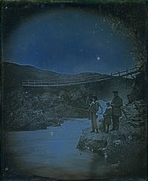
Fishing at the Falls of Rossie

Photo © Victoria and Albert Museum, London


A search of the 1841 Scottish census transcriptions on Ancestry.co.uk threw up nine David Dears, none of them a gamekeeper. But in 1851 the oldest of the eleven David Dears in the results was a gamekeeper (transcribed as ‘G Amekeeper’…), and was a servant in the household of one Horatio Ross at Gledfield in Kincardine. According to Ross MacLeod there is a gravestone in Kincardine Cemetery for a David Dear who died at Gledfield in 1855 aged 82 years, having served the family of Horatio Ross ‘upwards 60 years’. And, thrillingly, the Victoria and Albert museum in London has in its collection an item described as ‘Daguerreotype of Horatio and Colin Ross and Old David Dear fishing at the Falls of Rossie, taken in Scotland by Horatio Ross, 1848-1850’ (left).

To try to find out more about this David Dear I turned to the Scotland’s People site, where you can view images of census returns, death certificates and so forth (for a fee). I was excited to find out that from the start of civil registration in 1855 Scottish death certificates included detail on family background, including place of birth and the details of parents, spouse, and children. (There is more information on this on the Scotland’s People website, here.) Unfortunately, old David Dear’s death certificate provides very little information in this regard: the family sections are blank, even though he is listed as a widower in the 1851 census. Perhaps he was widowed so many years before that nobody could remember his family, but in any case this wasn’t very helpful in finding out whether he had a son called David who became an engineer and went to Northumberland. When I visited Who Do You Think You Are Live in February 2011 I asked a representative from the Scottish Archives about how to go about locating any papers from Horatio Ross’s estates, which I hope might contain information on old David Dear’s work for the family (even just a receipt for the gravestone), but she was unable to find anything in the on-line catalogue. At the nearby Science Museum stand I discovered that they have an archive which may be a source of information for David junior’s work as an engineer, but I’ve yet to follow up that line of enquiry.

So much for David, but what about Margaret senior? If Alice Halliday’s husband was ‘my’ David Dear then Margaret would presumably have made her way up to Northumberland of her own accord rather than as David’s wife. So I wondered if there was a mining connection – perhaps Margaret’s family had been involved in mining in Cornwall, and had moved to Northumberland to work in the mining industry there. That might even explain how Margaret met an engineer (in another branch of my family tree the daughter of a plasterer married the son of a gypsum miner). But I couldn’t find any Perrows in the Newcastle area in the 1841 census. I ordered the CD of Falmouth baptisms from Parish Chest and between 1776 and 1837 it has records for only six baptisms of children with the surname Perrow, all of them the children of John and Margaret. One of them, baptised 1 Jan 1818, was indeed named Margaret.* But John Perrow was a mariner, so bang went my theory about the mining connection, and the other children stayed in Falmouth. Why would Margaret have gone to Newcastle?

But was Margaret senior ever in Northumberland at all? At present the only information I have that links her with the area is the census record indicating that Margaret junior was born there. But was she really? In fact, other census records give conflicting evidence for Margaret junior’s birth place:
1851: Northumberland
1861: [No census record found]
1871: Newcastle on Tyne Northumberland
1881: Middlesex London
1891: Westmorland Kendal (actually, “)
I haven’t found any birth or baptism records for a Margaret Dear or Perrow in the Newcastle area in the relevant ten-year window – in fact, I haven’t found any anywhere. And I still haven’t found any marriage record for David and Margaret

So there are far too many ‘ifs’ in this line of my research for me to put the information I have so far on my main site. Any information would be gratefully received!

  • Where did David junior and Margaret senior meet?
  • Where was Margaret junior born/baptised?
  • Did Margaret senior ever spend time in Newcastle?
  • Did David and Margaret actually marry?
  • Was David the same man as the husband of Alice Halliday?
  • If so, how did the son of a gamekeeper become an engineer?

* Update 29th September 2019: my descent from the Falmouth Margaret has been confirmed by a DNA match to a descendant of her maternal aunt Joan Dunston.

Posted in Uncategorized | 3 Comments

The Ollivers of West Sussex

In April and May this year my research was focused on adding to my collection of information on my Olliver ancestors and their relatives.

I was particularly interested in a mystery which came to light right at the beginning of my research, but unfortunately I still haven’t got to the bottom of it. On the 1893 certificate of marriage between Bushby Olliver and Sophia Collins Bushby’s condition is given as bachelor. It’s a copy that has come down through the family, so one assumes that that is what Bushby told the Registrar. But between 1871 and 1881 Bushby had at least 6 children (of whom only 3 appear to have survived) with Harriet Hacker, who is described as his wife in the censuses. I haven’t been able to find any marriage certificate for Bushby and Harriet; although this doesn’t necessarily mean that they didn’t marry, it may be a likely explanation. It doesn’t help that I don’t know whether they met in Sussex or in London: in 1861 Harriet was still living in Sussex, but I haven’t been able to find a census entry for Bushby for that year. By the time of the 1871 census they were living together in London and their son Robert Bushby Olliver was born in the August of that year.

Bushby is still described as married in the 1891 census, when he is living with two of their three surviving boys, but I have not so far been able to locate Harriet in this census nor find any likely-looking death certificate for her. Perhaps she was in service and staying away from home on census night, or perhaps the family had split up? Curiously, Bushby is described as deceased on the 1908 marriage certificate of his youngest son by Harriet (who is not at home with Bushby in 1891). This threw me off the scent for a while when trying to find a death certificate for him as, in fact, he didn’t die until 1923. Had father and son just lost touch, or does this hint at some kind of family break-up? It seems strange that they weren’t in contact given that the 1908 wedding took place at St Philip Lambeth, less than a mile away from the Brixton Road addresses where Bushby was living between at least 1893 and 1901 (although he had moved away to Greenwich by 1911).

Another reason it took me so long to find a death certificate for Bushby is the number of mis-spellings of his (admittedly rather unusual) name in the records: I’ve found him indexed as Rushby, Bushley, and Buesley. Bushby’s name seems to have come from his grandmother, Ann Bushby, who married Edward Olliver in 1781. Ann lived to the ripe old age of ninety, dying in 1842.

In 1841 Ann had been living with her two youngest daughters, Jane and Emy, who were living in the intriguingly-named Miller’s Tomb Cottage by 1851. I thought at first that I had mis-read the address in the census entry, but a Google search turned up a number of images and articles, my favourite being Valerie Martin’s A Miller’s Tale. There is actually a Miller’s Tomb on Highdown Hill near Worthing, built by a John Olliver; John was, I believe, Jane and Emy’s great-uncle. Their father Edward was a miller too, as was their brother, Robert Bushby Olliver, Bushby’s father. Robert was living in Havant, Hampshire when his son Edwin was baptised in 1828 but had moved back to Worthing by the time his son Edward was baptised in 1833, shortly after Edward senior’s death.

In their old age, Robert and his wife Mary moved into Humphrys’ Almshouses in Worthing, where they lived until their respective deaths in 1859 and 1871. The Almshouses were founded in 1858 for Anglicans of Broadwater. In 1861 Mary was living at number 3; this house has been demolished but numbers 7 and 8 (left, built a few years later in 1867) were still standing in 2009. Mary’s death was reported by an Ann Olliver, who may have been Mary’s daughter-in-law, Ann Ayling, or her granddaughter, Ann Olliver.

So some questions remain. Where was Bushby in 1861? And what happened to Harriet?

Posted in Uncategorized | 5 Comments

Who Do You Think You Are Live 2011

This year I attended the Who Do You Think You Are Live exhibition for the first time. It was a bit of a trek (and I went along for all three days), but very much worth it: I met a number of people (below) who were able to point me towards some really exciting new avenues of investigation, and I had a really great time. I’m aiming to follow up these leads over the next year, so keep an eye on Jenny’s Genealogy for the results!

The National Archives of Ireland

We spoke to a very helpful gentleman who explained that ‘Kil-‘ in place names means ‘church’ and thought that the names of the siblings Honorah and Jeremiah Coughlin suggest that the family may have come from Munster. He was even able to give me the reference number of the microfilm of the records from the most likely parish.

Jayne Shrimpton

Jayne Shrimpton presented a very interesting workshop on family portraits. I showed her copies of some of the family photos at her photo-dating stand the next day, and we think that Alice Chapman’s photo may well be a 21st birthday portrait – she has a ribbon on her dress, and apparently the style of the sleeves dates the photo to the early 1890s (Alice was born in November 1870). Jayne thinks that the picture of the unknown Newland man is an enlargement of a small photo which has been touched up with pencil, and probably dates from the 1850s or 1860s.

Science Museum Library and Archives

May be a source on information on my engineer ancestors like David Dear and Robert Fiveash.

Families in British India Society

The lady we spoke to mentioned secret families, which made us wonder exactly what Thomas Fitzgerald got up to during his army service before he married at the age of 42…

Posted in Uncategorized | Leave a comment